
In Dr. Maria Montessori’s Own Handbook, Maria Montessori vividly describes the pedagogical power of the Pink Tower:
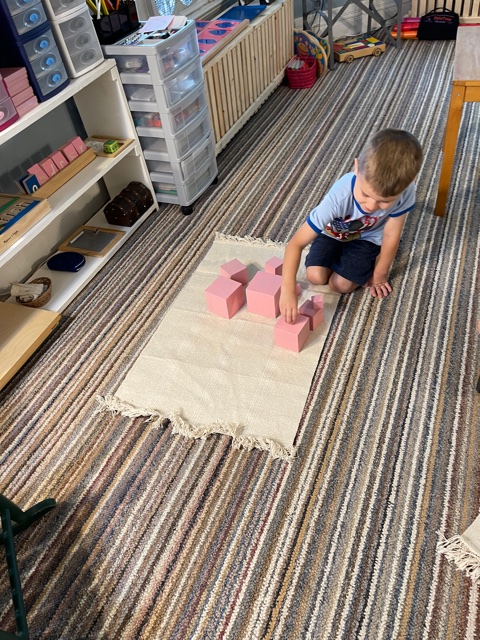
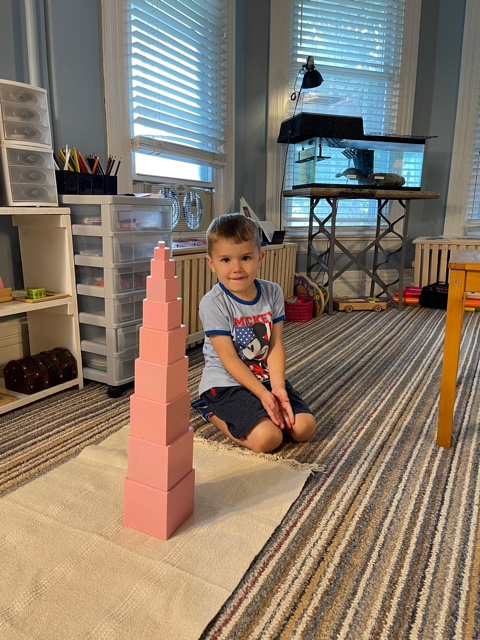
“Ten wooden cubes colored pink. The sides of the cubes diminish from ten centimeters to one centimeter. With these cubes the child builds a tower, first laying on the ground (upon a carpet) the largest cube, and then placing on the top of it all the others in their order of size to the very smallest. As soon as he has built the tower, the child, with a blow of his hand, knocks it down, so that the cubes are scattered on the carpet, and then he builds it up again.” (p. 72)
The Pink Tower is one of the most enduring icons of Montessori education. Designed with precision by Dr. Montessori, it has remained unchanged for over a century and graces every Montessori classroom worldwide.
What It Is
Ten wooden cubes, uniformly pink, with sides ranging from 1 cm to 10 cm. Each cube differs in all three dimensions, creating a perfect gradient of size.
A Gateway to Intelligence
Far more than a simple stacking game, the Pink Tower is a cornerstone of the Sensorial Area. Dr. Montessori designed these materials to sharpen the senses and lay the foundation for intellectual growth.
- Isolated variable: Same color, shape, and texture—forcing focus on size alone.
- Visual discrimination: Children detect subtle differences in dimension.
- Tactile awareness: Carrying cubes (often starting with the smallest) reveals weight progression.
- Motor refinement: Precise placement builds voluntary control and hand-eye coordination.
At first, a child’s tower may wobble or collapse. Through repetition, their movements become deliberate. Precision in action becomes self-mastery.
The built-in control of error—a misaligned cube is visibly wrong—empowers the child to self-correct, fostering independence and confidence.
Seeds of Language and Mathematics
The Pink Tower plants indirect preparations for later learning:
| Area | Preparation |
|---|---|
| Language | Three-finger grip prefigures pencil hold; vocabulary expands (“cube,” “largest,” “smaller than”) |
| Mathematics | 10 cubes introduce the decimal system; exploring volumes sparks geometric intuition |
These concepts aren’t taught—they’re absorbed by the child’s absorbent mind.
Why Pink?
Montessori tested colors and found children gravitated toward pink. Every detail, down to hue, serves the developing mind.
In its elegant simplicity, the Pink Tower reveals the genius of Montessori’s Sensorial curriculum: a single material, infinite lessons.
 littleleaharrodsburg.com